
Description
Still, the rudimentary production will frustrate fans who seek sonic perfection from mid-century pioneers. Tyners piano is muffled enough on My Favorite Things that his parts can sound like ghostly percussion unless you focus on them. Basslines are sometimes difficult to unearth from the tumult, with the notable exception of Africaditto Dolphys more delicate trills. Scores of Coltrane heads weaned themselves on the impressive fidelity of Live at the Village Vanguard and 1964s Live at Birdland, both of which were captured with extreme stereo know-how by Rudy Van Gelder. Fans expecting this treatment may be displeased, but their reactions befit the artistColtrane never liked meeting expectations.
His Village Gate set offers us something beyond pristine audio: extraordinary energy. The parts we cannot clearly perceive murmur away, offering fullness to the music anyway. Improved sound quality wouldnt make the listening experience more authenticbut it could make it fussy, more in keeping with sterile 21st-century airpods than an acoustically challenged Bleecker Street basement in the early 60s. (This basement remained a venue, Le Poussin Rouge, after the Gate closed 30 years ago; the ground floor, naturally, has become a CVS.) Alderson placed his single mic near Elvin Jones, whose elastic drumming feels like a marvelous solo act. He flails against orthodoxy, rattles the bars of swing time and jeers at the expectations of consistency that percussionists have to shoulder. Ostensibly a timekeeper, Jones was the wildest member of Coltranes 61 quartet, and perhaps as a result he was the last player of this era that Coltrane would replace.
At the end of the year, Workman left his father was sick and Coltrane had a new trajectory in mind. Dolphy departed soon after, eventually joining Charles Mingus band for the second time, where his deft reedwork could take center stage. The quartet reshuffled as Coltrane surged forward. These Village Gate performances, though, continued to reverberate in his own music and in music at large. There were precedents for composers using two bassists, but arguably no one before Coltrane had saddled one bassist with roving lead parts and another with a stationary, raga-inflected drone. Coltrane battle-tested this dynamic at the Gate, and then developed it over the years. His experimentation signaled something both impractical and studied, a breakdown of big-band largesse into the endless permutations that opened to jazz musicians as 50s conventions fractured into parallel universes of sound. Within a month of the Gate performances, Ornette Coleman released Free Jazz: A Collective Improvisation, which used two bassists. In 1966, Cecil Taylor doubled up bassists on his uncompromising Unit Structures. By 1970, Coltranes former boss Miles Davis was using two bassists on a game-changing release in a far different vein, Bitches Brew.
The poet and jazz critic Amiri Baraka (then known as LeRoi Jones), in his gorgeous liner notes to Live at Birdland, called McCoy Tyner the polished formalist of the group and claimed that he played more cautiously than his bandmates. Barakas comment became writing on the wallin 1965, Coltrane replaced Tyner with his wife, Alice Coltrane. But the saxophonist was merely trying out something new, not deriding something old. Perhaps because he died tragically young, its easy to imagine that Coltrane had a destination in mind with his music, some heavenly realm formed of sacred geometries and unceasing magic-hour light, where an even more classic quartet plays nonstop with Rudy Van Gelder perched behind the sound boards. In reality, had Coltrane lived to ripe old age, he would have continued to try out different styles, bands, influences and ideas, no doubt jamming with past collaborators along the way. Squabbles about sound quality, and comparisons between various iterations of his quartet, are never convincing: John Coltrane cared about change, not perfection.
He played My Favorite Things” during his last recorded concert, in 1967, at the Olatunji Center for African Culture in Harlem. The version bears no similarity to the original except for a several-second phrase during a breathless solo. These familiar notes are surprising after an onslaught of free jazz, masterminded by a terminally ill genius who had passed through all sorts of flames in order to become the most transformative, intense and grating saxophonist in the world. Then again, Coltrane once said that he considered My Favorite Things to be the best recording he ever made. He liked the composition because he could play it fast or slow, because it renews itself according to the impulse you give it, because it was a good place to start.
On Evenings at the Village Gate, Coltrane treats his hit as raw material. He adapts it for another soloist, and rebuilds it into other tracks, one of which he dedicated to Africa. The experience recalls a quote that, like his music, has been referenced too often but retains its grandeur all the same: I want to start in the middle of a sentence and then go both directions at once. Coltrane reaches at once into the future and the place where music began. He touches the primeval and follows along with the changes. (via Pitchfork)
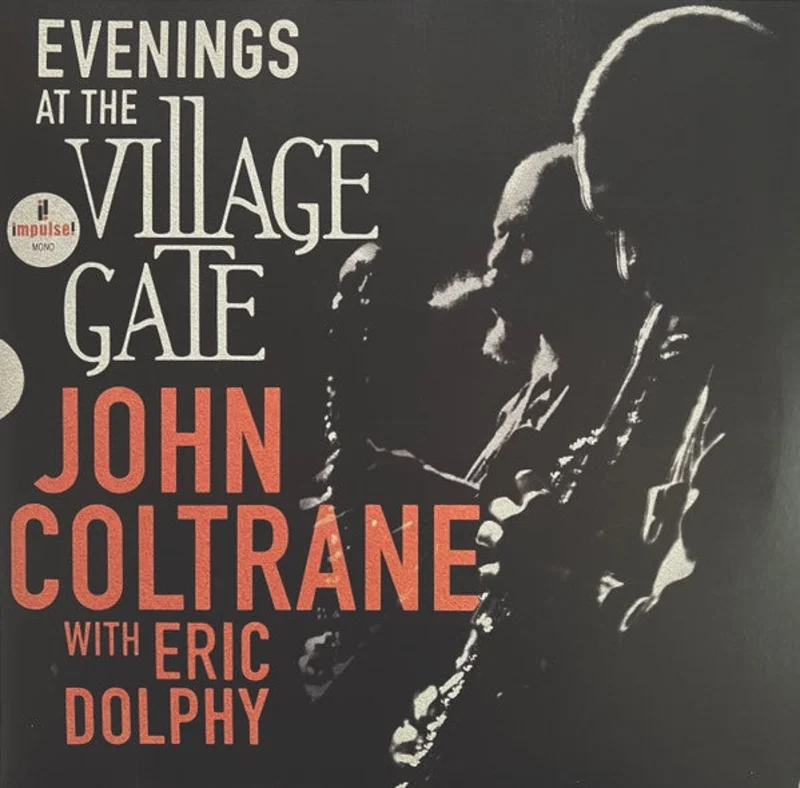
Another new album by John Coltrane, this recording was rediscovered in the New York Public Library, where it had been deposited in the late 1960s or early 70s. The recordings were made over two nights during a summer season in 1961 by the clubs sound engineer, Rich Alderson, with a single microphone suspended over the stage. Alderson provides some details in an essay accompanying the [album: he hadnt intended to record the music for posterity; rather, he wanted to know what the sound was like.
The single microphone means the music is in mono, and as with many bootleg recordings, some instruments are recorded better than others. The contributions by Coltrane and multi-instrumentalist Eric Dolphy are clear, as is Elvin Jones drumming, but McCoy Tyners piano and Reggie Workman and Art Davis basses can be indistinct, especially when other instruments are soloing.
This is Coltrane in a period of transition: hed had significant success earlier in the year with his My Favourite Things album, and hed experimented with a larger ensemble on the yet-to-be released Africa/Brass. Also, his classic quartet had yet to coalesce.
The recording captures the excitement of the band live, particularly on the in-concert staples, My Favourite Things, Impressions and Greensleeves. Compared to My Favourite Things, the less familiar When the Lights Are Low seems almost ordinary, but it contains some beautiful playing, including a superlative solo by Tyner.
Dolphy consistently pushes boundaries indeed, he sounds more adventurous than Coltrane much of the time although on the particularly fast Impressions, Coltranes soprano reaches new highs, its repetitiveness being almost hypnotic.
At over twenty minutes, Africa is the longest piece and features an extended bass section, Davis soloing while Workman maintains the groove. It also includes the albums only drum solo, although the sheer physicality of Jones drumming generally pushes the music along and the band re-entering after his solo provides its most exciting point.
There are many live recordings of John Coltrane. The one I return to most is Afro Blue Impressions probably because it was the first one I heard. Evenings at the Village Gate holds its own against that, and against the Complete Village Vanguard Sessions from the same year. So, while this might not be the first Coltrane live recording one will turn to, should you feel the need for another version of Impressions, My Favourite Things and Greensleeves, its essential. (via Patrick Hadfield // UK Jazz News)
Label: Impulse!, UMe
Format: 2 x Vinyl, LP, Album, Mono, Gatefold
Released: 2023 / Recorded: 1961
Genre: Jazz
Style: Modal
File under: Jazz
Reviews
There are no reviews yet.